Showing posts with label Russia. Show all posts

Tuesday, December 26, 2023

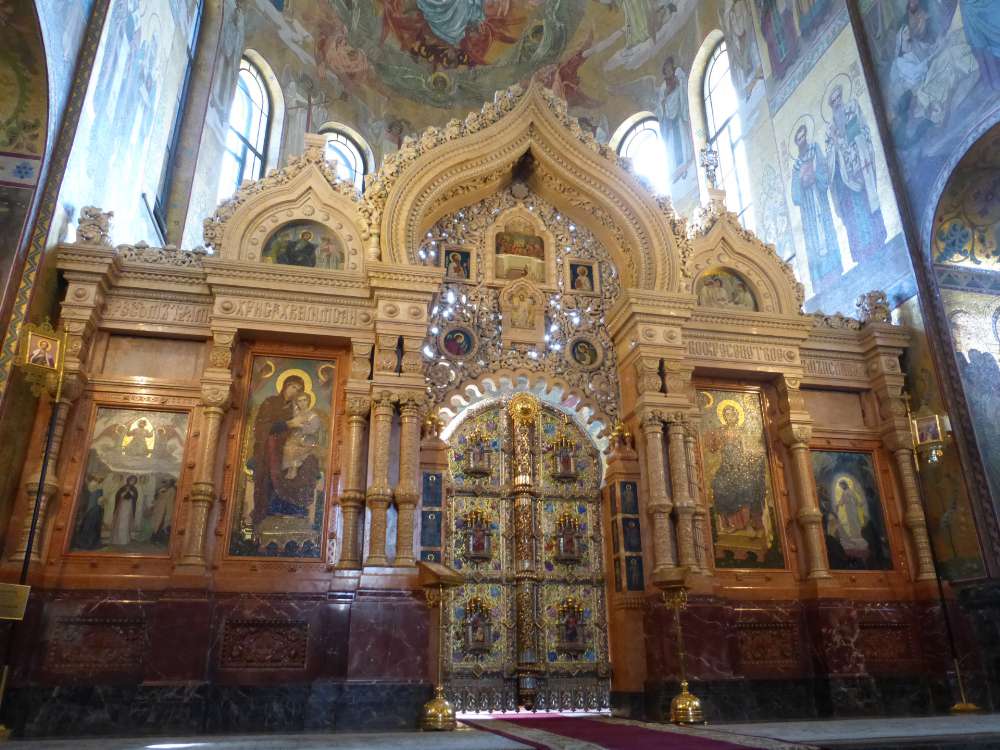
Wordless Wednesday Church of the Saviour on the Spilled Blood.

The Church of the Saviour on the Spilled Blood was built on the place where the Romanov family was assassinated. More information can be found here. 

The photos are not good quality because we couldn't use a flash.


This door and much of the interior is made up of millions of tiny mosaic tiles.

I am joining Sandee at Comedy Plus for the blog hop.


Tuesday, September 26, 2023

Wordless Wednesday - Peterhof Palace.

 Peterhof Palace, St. Petersburg, Russia.

The palace.


The Cascade.

"One of St. Petersburg's most famous and popular visitor attractions, the palace and park at Peterhof (also known as Petrodvorets) are often referred to as "the Russian Versailles", although many visitors conclude that the comparison does a disservice to the grandeur and scope of this majestic estate.

Versailles was, however, the inspiration for Peter the Great's desire to build an imperial palace in the suburbs of his new city and, after an aborted attempt at Strelna, Peterhof - which means "Peter's Court" in German - became the site for the Tsar's Monplaisir Palace, and then of the original Grand Palace. The estate was equally popular with Peter's daughter, Empress Elizabeth, who ordered the expansion of the Grand Palace and greatly extended the park and the famous system of fountains, including the truly spectacular Grand Cascade.

Improvements to the park continued throughout the 18th and 19th centuries. Catherine the Great, after leaving her own mark on the park, moved the court to Pushkin, but Peterhof once again became the official Imperial Residence in the reign of Nicholas I, who ordered the building of the modest Cottage Palace in 1826.

Like almost all St. Petersburg's suburban estates, Peterhof was ravaged by German troops during the Second World War. It was, however, one of the first to be resurrected and, thanks to the work of military engineers as well as over 1,000 volunteers, the Lower Park opened to the public in 1945 and the facades of the Grand Palace were restored in 1952. The name was also de-Germanicized in 1944, becoming Petrodvorets, the name under which the surrounding town is still known. The palace and park are once again known as Peterhof."


I am joining Sandee at Comedy Plus for the blog hop.


Tuesday, September 12, 2023

Wordless Wednesday

 The red columns in St. Petersburg are called rostral columns. Since ancient times, and particularly Ancient Rome, architects used to “decorate” columns with trophies - the prows or rams of the defeated ships, which, in Latin, are called ‘rostrum’.

The more rostrums, the more enemies should be frightened to attack the navy. And more people would be proud of their country. 

Another famous example of the rostral column is the Columbus Monument at Columbus Circle in New York City. There are also rostral columns in French Bordeaux, on the place des Quinconces.


I am joining Sandee at Comedy Plus for the blog hop.


Tuesday, June 20, 2023

Wordy Wednesday - St. Petersburg, Russia.

As we will never revisit Russia I thought I would do it with selected posts from our 2014 cruise.
The embankment on the Neva River with one of the pair of Sphinx in the background.

I hadn't realised how old the Sphinx were until I looked it up. I knew they had come from Egypt originally but was amazed to learn how old they were. This is what I read about them:

"The two magnificent sphinxes on Unversitetskaya Naberezhnaya (University Embankment), in front of the Academy of Fine Arts, are roughly 3,500 years old and are considered among the finest examples of Ancient Egyptian colossal sculpture kept outside Egypt. They once stood on the Alley of Sphinxes in front of the tomb of Pharaoh Amenhotep III. For nearly two centuries, however, it has been the waters of the River Neva rather than the Nile that reflect in their bottomless eyes."
"The sphinxes were discovered during excavations in the 1820s, and were soon written about by the great French Egyptologist Jean-Francois Champollion. At the beginning of the 1830s, they were bought in France on behalf of the Russian Emperor and shipped to St. Petersburg. Carved from pink granite, the sphinxes weigh around 23 tons each, and the great neo-classical architect Konstantin Ton designed their pedestals and the granite pier, with its bronze lamps and griffins."


One of the gryphons (griffins).


The English Embankment.


The Imperial Academy of Arts on the Academy Quay of the Neva River.


I am joining Sandee at comedy Plus for the blog hop.

Tuesday, June 6, 2023

Wordless Wednesday.

Our second and now obviously final visit in 2018 to St. Petersburg, Russia.


 The Lakhta Center is an 87-storey skyscraper built in the northwestern neighbourhood of Lakhta in Saint Petersburg, Russia. Standing 462 metres tall, it is the tallest building in Russia, the tallest building in Europe, and the sixteenth-tallest building in the world.


The second day we were there England were playing Croatia in the football World Cup semi finals (they lost!). We had been asked if we wanted tickets but declined, and looking at the huge queues I am very glad we did.


I am joining Sandee at Comedy Plus for the blog hop.


Thursday, June 28, 2018

Baltics Cruise July/August 2014 Russia Pt. 5.

At last I have reached the final part of our two day stay in St. Petersburg with this post.
After we came out of The Hermitage there was a military display going on as it was Paratroopers Day. Our guide told us that after the marching it is a time for veterans and new recruits to let their hair down. They drink until they fall down and are left where they fall. He advised against staying too long once that started, because so do the fights.


After we left there we went to the Church of the Saviour on the Spilled Blood. It was built in memory of Alexander II who was assassinated in 1881, and stands on the very place where a bomb was thrown into his carriage by a man who opposed the Tsar's reforms. It took 24 years to build.


The interior is decorated completely in mosaics, each mosaic being a tiny piece. Below are some of the photos I took there. I had trouble getting clear photos because of the reflection from them.


Saints Peter and Paul Cathedral built between 1712 and 1733. It was built during the rule of Peter the Great and has the world's tallest orthodox bell tower.


The remains of almost all of the Russian Emperors and Empresses are buried here since Peter the Great.


Nicholas II and his family were finally laid to rest here in July 1998.
You can read more about it here.
That ends our stay in Russia. Next is Helsinki, Finland.

Wednesday, June 20, 2018

Baltics Cruise July/August 2014 Russia Pt. 5 The Hermitage 2.

I was originally going to do The Hermitage all in one post but as there are so many I decided to split it into two parts.
This post includes some of the huge amount of art. There is some blur and reflection as a lot of it is behind protective glass.


The Great Throne Room.

Catherine's Hanging Gardens which are at second floor height and link the north and south wings.


Well that is it from inside The Hermitage.
I still have more photos from St. Petersburg as well as some more places we visited on that cruise but I need to take a break from them and post some more recent trips we took in the UK first.